

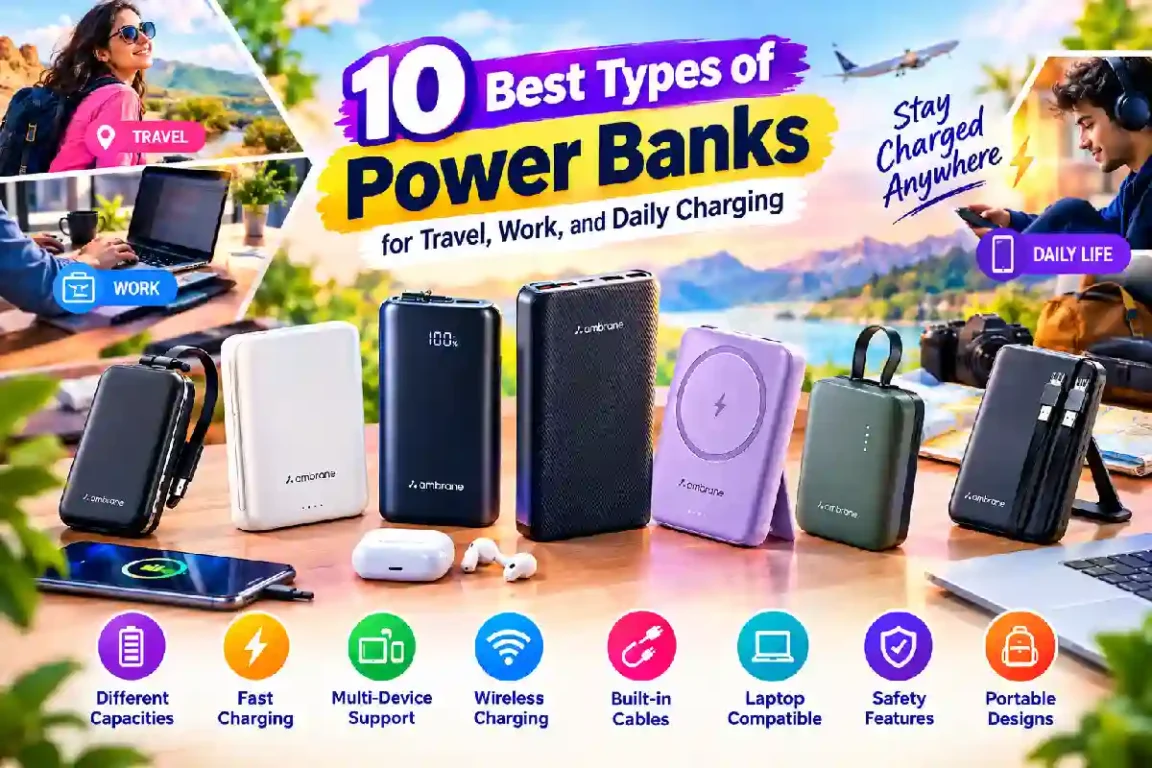
A smartphone running out of battery during navigation, a laptop losing charge during an important meeting or wireless earbuds switching off while travelling can disrupt your routine. With several electronic devices becoming part of everyday life, carrying a reliable power bank is increasingly useful.
However, power banks differ in battery capacity, charging output, portability and compatibility. A compact model may be sufficient for daily commuting, while frequent travellers and remote workers often require greater capacity and faster charging.
Choosing from the best power banks means understanding which type meets your charging requirements. This guide covers 10 types of power banks for different situations, along with their features and practical applications.
-
This article is part of Tech
10000mAh Power Banks for Everyday Smartphone Charging
A 10000mAh power bank is suitable for users who need additional smartphone battery backup during regular activities. These models generally balance battery capacity with portability, making them convenient for office bags, college backpacks and short outings.
Depending on your smartphone’s battery capacity and charging efficiency, a 10000mAh model can provide approximately one to two full charges.
Key Features:
- Compact and lightweight construction
- 10000mAh battery capacity
- USB-A or USB-C charging options
- Compatibility with smartphones and small electronic accessories
Suitable For: Students, office workers and daily commuters.
The Ambrane Stylo N10 is an example of a 10000mAh power bank with a built-in charging cable.
-
20000mAh Power Banks for Long Travel Days
Long journeys often involve extended smartphone usage for navigation, entertainment, photography and communication. A 20000mAh power bank provides greater energy storage than a 10000mAh model.
These power banks are useful for overnight trips, road journeys and situations where charging outlets are not readily available. They can also support compatible tablets and other portable electronic devices.
Key Features:
- 20000mAh battery capacity
- Multiple charging outputs on supported models
- Fast charging compatibility
- Battery status indicators
Suitable For: Frequent travellers, content creators and people spending long hours outdoors.
Models such as the Ambrane MiniCharge 20 and Stylo N20 offer 20000mAh capacity with built-in charging cables.
-
Fast-Charging Power Banks for Busy Work Schedules
When time is limited, a fast-charging power bank can help recharge compatible smartphones more quickly than a conventional low-output model.
These power banks support charging technologies such as USB Power Delivery and other fast-charging protocols. Actual charging speed depends on the connected device, supported wattage and cable compatibility.
For professionals moving between meetings or commuting across cities, fast charging can reduce the time spent connected to a portable charger.
Key Features:
- Fast charging output
- Compatible USB-C connectivity
- Support for relevant charging protocols
- Protection against excessive current and overheating
Suitable For: Business professionals, frequent commuters and smartphone users with demanding schedules.
Before purchasing, compare the power bank’s output rating with your smartphone’s supported charging requirements.
-
Laptop Power Banks for Remote Work and Business Travel
Laptops generally require higher charging outputs than smartphones. A standard mobile power bank may not provide enough power to charge a laptop, especially when it is in active use.
Laptop-compatible power banks support higher power delivery through USB-C and are useful for working from cafés, attending meetings outside the office or travelling between locations.
Check the laptop’s USB-C charging support and required wattage before choosing a compatible power bank.
Key Features:
- Higher USB-C Power Delivery output
- Battery capacity suitable for laptop charging
- Compatible USB-C charging cable
- Multiple charging options on supported models
Suitable For: Remote workers, students, designers and business travellers.
The Ambrane Powerlit Ultra 240 and Stellar 40K are examples of laptop-compatible power banks designed for higher charging requirements.
-
Wireless Power Banks for Cable-Free Smartphone Charging
Wireless power banks allow users to charge compatible smartphones without physically connecting a charging cable.
They use wireless charging technology to transfer energy between the power bank and the device. Some models feature magnetic alignment to help maintain the correct charging position.
Although wireless charging provides convenience, it may be less energy-efficient than wired charging, depending on the technology and charging conditions.
Key Features:
- Compatible wireless charging support
- Magnetic alignment on selected models
- Portable battery capacity
- Optional wired charging connectivity
Suitable For: Smartphone users who prefer fewer cables during daily activities.
The Ambrane Aerosync Snap is an example of a 10000mAh magnetic wireless power bank designed for compatible iPhones.
-
Power Banks with Built-In Cables for Daily Commuting
Forgetting a charging cable can make a conventional power bank difficult to use. Power banks with integrated cables address this problem by providing an attached charging connector.
These designs are convenient for people who regularly travel between home, college and the workplace. They also reduce the number of separate accessories users need to carry.
However, connector compatibility remains important. Before buying, ensure the integrated cable supports your device.
Key Features:
- Built-in charging connector
- Portable construction
- Reduced need for separate cables
- Fast charging support on selected models
Suitable For: College students, daily commuters and travellers.
The Ambrane Stylo N20 and MiniCharge 20 are examples of power banks that incorporate built-in charging cables.
-
Compact Power Banks for Pocket-Friendly Portability
Compact power banks prioritise portability and convenient everyday handling. Their smaller dimensions make them easier to carry inside pockets, small handbags or lightweight backpacks.
These models work well for users who need occasional charging rather than extensive battery backup. Capacity and output vary, so a small design should not automatically be considered suitable for every smartphone.
Key Features:
- Space-saving dimensions
- Lightweight construction
- Convenient charging connectivity
- Battery capacity suited to occasional charging
Suitable For: Students, shoppers and people travelling with minimal accessories.
When comparing compact models, consider their physical dimensions, weight, capacity and charging output together.
-
Multi-Port Power Banks for Charging Several Devices
A person carrying a smartphone, wireless earbuds and a tablet may need to charge multiple devices during the same journey.
Multi-port power banks provide several compatible charging connections, allowing users to connect more than one device simultaneously.
However, simultaneous charging performance depends on the power bank’s combined output capacity. Connecting additional devices can reduce the power available to individual ports.
Key Features:
- Multiple USB charging outputs
- Simultaneous charging capability
- Compatible charging protocols
- Sufficient combined output wattage
Suitable For: Families, colleagues and users carrying multiple devices.
Multi-port power banks are particularly useful during group travel and shared charging situations, provided the connected devices remain within the supported output limits.
-
High-Capacity Power Banks for Extended Outdoor Activities
High-capacity power banks are designed for situations requiring greater stored energy, such as extended road trips, outdoor assignments and locations with limited charging access.
Models offering 27000mAh, 40000mAh or larger capacities may support multiple charging sessions, depending on the devices connected and overall energy conversion efficiency.
The trade-off is usually greater weight, larger dimensions and longer recharging times.
Key Features:
- High battery storage capacity
- Support for compatible high-output devices
- Battery monitoring indicators
- Appropriate charging protection features
Suitable For: Outdoor professionals, long-distance travellers and users requiring extended backup.
The Ambrane Stellar 40K is an example of a 40000mAh power bank intended for charging compatible laptops and other electronic devices.
When travelling by air, always check the battery’s watt-hour rating and the airline’s restrictions. Some high-capacity power banks may exceed permitted cabin baggage limits.
-
Magnetic Power Banks for Convenient On-the-Go Charging
Magnetic power banks attach to compatible smartphones using magnetic alignment. They help keep the charging surface positioned correctly without requiring a separate cable.
Some magnetic power banks also support Qi2 wireless charging, while others provide additional wired connectivity. These models can be useful during daily commuting, casual browsing and travel.
Key Features:
- Magnetic attachment compatibility
- Wireless charging support
- Compact charging design
- Optional wired charging output
Suitable For: Users with compatible magnetic wireless charging smartphones.
The Ambrane AerosynQ Snap 2 and AerosynQ MagSurge are examples of 10000mAh Qi2-certified magnetic wireless power banks.
How to Choose the Right Power Bank for Your Needs
Choosing a power bank involves evaluating battery capacity, device compatibility and charging convenience. The following factors can help narrow down your options.
Consider Your Battery Capacity Requirements
A 10000mAh power bank is generally practical for everyday smartphone charging. Users requiring additional backup can consider 20000mAh models, while demanding laptop charging or extended outdoor use may call for higher-capacity alternatives.
Check Charging Speed and Compatibility
Power banks support different charging protocols and wattage levels. Confirm that the model is compatible with your smartphone, laptop or other electronic device before purchasing.
Compare Portability and Design
Compact models are easier to carry during daily commuting, while larger power banks provide additional capacity at the expense of portability. Choose according to how frequently you travel and how many devices you carry.
Plan Your Charging Setup at Home and Work
Power banks are useful when you need portable battery backup, but they still require regular recharging from a suitable power source.
At a fixed desk or home workstation, extension boards can provide additional power sockets for compatible chargers and electronic devices. They complement power banks by helping organise charging where mains electricity is available.
Always check the extension board’s load rating and avoid exceeding its electrical limits.
Prioritise Charging Safety
Choose a power bank with appropriate safety protection and verified specifications. Avoid damaged cables, exposure to excessive heat and incompatible charging accessories.
Conclusion
Different charging situations require different power bank features. A compact 10000mAh model may be sufficient for daily commuting, while 20000mAh options are useful for extended travel. Laptop-compatible, wireless and high-capacity power banks address more specialised charging requirements.
Before purchasing, compare the battery capacity, supported output, portability and compatibility of different models. Selecting a power bank around your actual device requirements can make portable charging more practical and convenient.

Afiya Jafar is a technology and digital trends writer at TechWebin. She creates reader-focused content covering technology, software, apps, digital tools, web technologies, gadgets and emerging digital trends.
View Profile →
Sameena Begum is a technology and digital content reviewer at TechWebin. She reviews selected content for clarity, organisation, consistency, readability and overall editorial quality.
View Profile →