

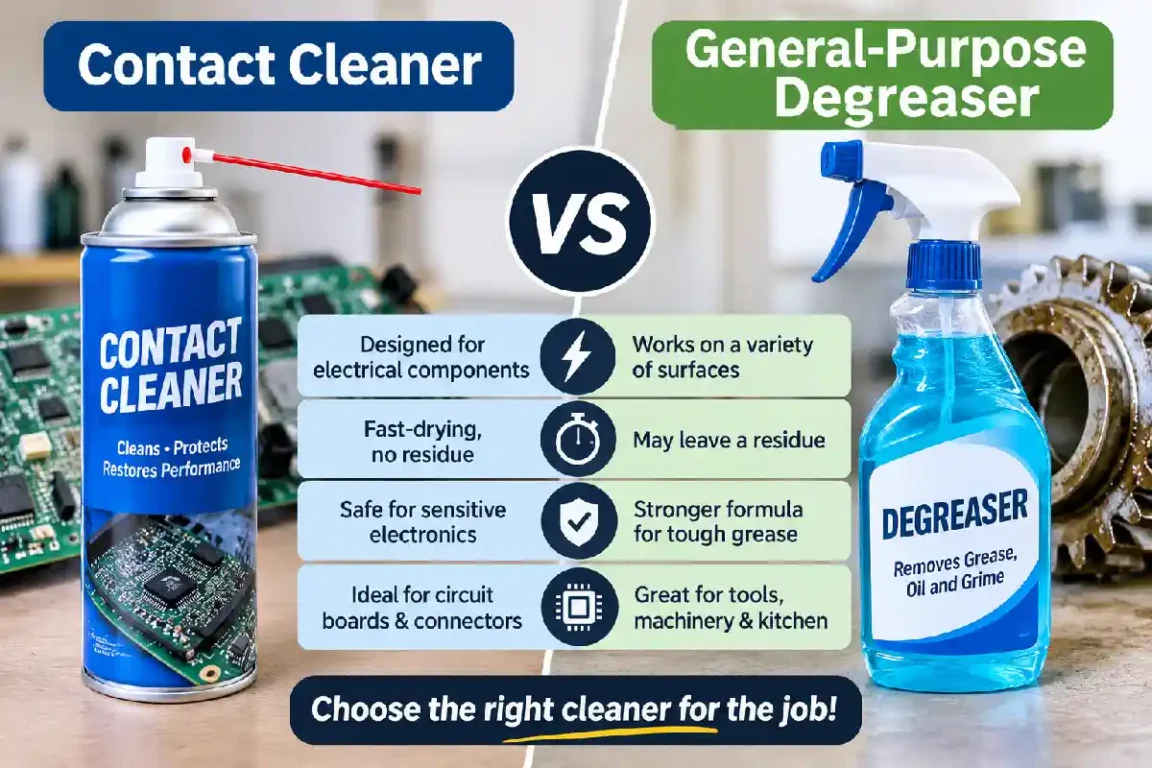
The effective maintenance of electrical equipment, switches, connectors, and control panels hinges to a great extent on the right cleaner being chosen. If the wrong product is selected for the job, this can have adverse implications for conductivity, potentially sensitive materials such as plastics, and workplace safety.
Specialist electrical contact cleaning products and everyday workshop degreasers are both designed to remove unwanted contaminants. However, they differ in the exact purposes they serve and how they are formulated.
With all this in mind, here are the essentials for maintenance professionals to know about as they seek to decide between these cleaner types in various contexts.
What Is a Contact Cleaner?
Contact cleaners are also sometimes referred to as “electrical contact cleaners” or “switch cleaners”. Often but not always solvent-based, these products are designed specifically for cleaning the conductive surfaces of electrical and electronic components, encompassing the likes of connectors, switches, relays, potentiometers, battery terminals, and printed circuit board (PCB) edge connectors.
If contaminants such as dust, dirt, light oils, oxidation, or flux residues are allowed to gather on these components, the consequences can range from heightened electrical resistance and intermittent faults to arcing, overheating, and/or complete failure.
Contact cleaners are formulated with the purpose of dissolving and flushing away contaminants like these. This can be key to maintaining dependable electrical connections and reducing the likelihood of problems associated with dirt and residue buildup.
What Are Contact Cleaners Like?
There are certain characteristics noticeable across the range of contact cleaners available on the market. Many contact cleaners, for instance, are designed to evaporate fast with little or no residue. They are also often compatible with the various plastics, rubbers, and metals commonly used in electronics.
Nonetheless, it is important to emphasise that contact cleaners are not all identical. So, prospective users of a particular product are advised to consult the manufacturer’s instructions before they apply it to a given electronic assembly.
What Is a General-Purpose Degreaser?
General-purpose degreasers are cleaning products designed primarily to dissolve and eradicate grease, oils, and other stubborn contaminants from surfaces. Both solvent-based and water-based options are available. These everyday degreasers are especially strongly associated with the removal of heavier grease, oil, grime, lubricants, tar, and industrial soils from mechanical parts, machinery, tools, engines, chains, and bearings.
It isn’t always the case that general-purpose degreasers are formulated with heavy-duty industrial applications expressly in mind; some are intended for lighter cleaning tasks.
However, these products do tend to be particularly commonly used across industrial maintenance sites, workshops, manufacturing facilities, garages, and other working environments where machinery and equipment can collect substantial amounts of dirt and oily deposits.
What Are General-Purpose Degreasers Like?
As with contact cleaners, it is important to be mindful of how general-purpose degreasers vary in their formulations. These products do, after all, come in many different forms, also encompassing both concentrated and ready-to-use variants.
As the term “general-purpose” implies, these degreasers aren’t necessarily formulated for use on electrical contacts or sensitive electronic assemblies.
Many general-purpose degreasers are more aggressive than contact cleaners, and it may be necessary to rinse or wipe after application. Some leave residues or take longer to dry. Users should be vigilant, too, about the possibility of certain solvent types attacking plastics, paints, or rubber seals.
In Summary, When Should Each of These Cleaning Products Be Used?
The decision between whether to use a contact cleaner or a general-purpose degreaser will come down to such aspects as the component to be cleaned, the type of contamination that needs to be eradicated, and material compatibility:
- A contact cleaner will typically make the most sense when the goal is reliable electrical performance. It is the safer choice of product to use around the sensitive electronics and plastics found in modern devices; think the likes of switches, connectors, terminals, control panels, and PCB contacts.
- A general-purpose degreaser will likely be the option to pick when there is a need to clear away heavy oils and grease from surfaces such as engine bays (away from electrics), machinery frames, tools, chains, bearings, or workshop surfaces. Standard degreasers should not be applied directly to electrical contacts or circuit boards.
In some situations, the cleaning requirements may be mixed (for example, a motor with both mechanical grease and electrical connections). In cases like these, the appropriate approach is typically to isolate and de-energise the equipment prior to cleaning. Mechanical parts can then be treated with a suitable degreaser, taking care to prevent the product from reaching electrical components.
In a mixed situation like this, once the degreaser has been removed and the area is suitably dry, electrical contacts can be carefully treated with a dedicated contact cleaner. All cleaning products should be permitted to dry thoroughly, with adequate ventilation provided, ahead of the equipment being returned to service.
By matching the product to the job, maintenance personnel can go a long way to reducing downtime, preventing damage, and improving the reliability of equipment.

Afiya Jafar is a technology and digital trends writer at TechWebin. She creates reader-focused content covering technology, software, apps, digital tools, web technologies, gadgets and emerging digital trends.
View Profile →
Sameena Begum is a technology and digital content reviewer at TechWebin. She reviews selected content for clarity, organisation, consistency, readability and overall editorial quality.
View Profile →